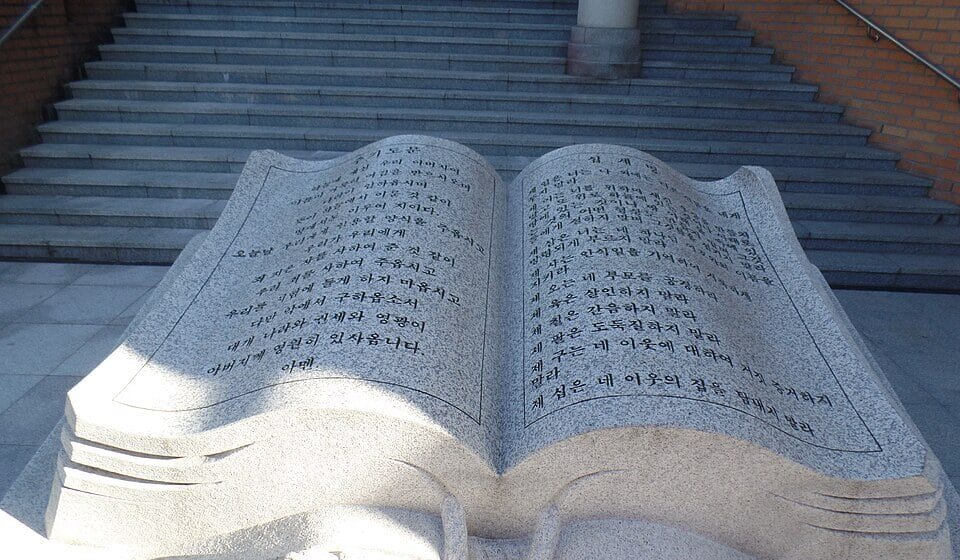
One Nation often presents itself as a defender of traditional Australian and Christian values. That makes the Ten Commandments a useful ethical test—not because a political party should behave like a church, but because a movement invoking traditional morality should be open to being measured against it.
This is not an accusation that One Nation politicians have literally committed every prohibited act below. Instead, it asks whether the party’s policies, rhetoric and conduct fit broader biblical principles such as concern for the poor, respect for life, honesty, self-control and love of neighbour. The issue is consistency, not whether every One Nation policy is anti-Christian.
1. “You shall have no other gods before me”
Exodus 20:3
One Nation’s immigration policy is titled “Putting Australians First”. It proposes lower immigration, an eight-year citizenship waiting period, changes to student visas, temporary protection visas and withdrawal from the UN Refugee Convention.
Patriotism and nationalism are not inherently contrary to Christianity. The tension appears when loyalty to nation becomes the highest moral good. In the Good Samaritan, Jesus deliberately makes an outsider the person who acts with compassion.
A biblical ethic therefore asks whether foreigners and refugees still possess equal human dignity. “Australia first” may be a political slogan, but no nation can occupy the place reserved for God.
2. “You shall not make for yourself an idol”
Exodus 20:4–6
Idols are not always statues. Money, ideology and political personalities can become objects of excessive loyalty.
Jesus warned: “You cannot serve both God and money” (Matthew 6:24). One Nation also supports some cost-of-living measures, including opposition to a higher GST and fuel-excise relief.
But its fiscal program also calls for cuts of up to $90 billion a year. Its published plan includes means-testing the NDIS, changing disability-support pricing, cutting foreign aid, reducing arts and multicultural funding and removing some accessibility requirements from building rules.
Government efficiency matters. Yet biblical teaching warns against allowing wealth preservation to outrank care for people in need. The ethical question is who carries the cost when spending is cut.
Political personality can become an idol too. The party is literally called Pauline Hanson’s One Nation. Strong leadership is not inherently unhealthy, but loyalty to a leader should not replace applying the same moral standards to allies and opponents.
3. “You shall not misuse the name of the Lord your God”
Exodus 20:7
This commandment is often reduced to swearing, but it also concerns using God’s name for purposes that contradict the values being claimed.
In 2026 Hanson called multiculturalism “utterly flawed” and argued Australia should be multiracial but “monocultural”. One Nation has also advocated deep immigration cuts and restrictions on migration from countries it associates with extremist ideologies.
Those positions can be debated politically. But Christianity is not simply another name for Western civilisation or cultural uniformity. The New Testament repeatedly crosses ethnic and national boundaries: the outsider becomes neighbour and the stranger is welcomed.
4. “Remember the Sabbath day, to keep it holy”
Exodus 20:8–11
The Sabbath teaches that people are worth more than their economic output. Rest, family life and human limits matter.
At the National Press Club in June 2026, Hanson questioned why businesses should pay women who are “not at work” and opened the door to revisiting paid parental leave. She later clarified that she did not want to abolish the government scheme and said she supported 26 weeks of taxpayer-funded parental leave.
That clarification matters. Pregnancy, childbirth, recovery and caring for a newborn may not appear on a productivity spreadsheet, but they are essential workers for families and society.
The same principle applies to disability support and low-paid work. One Nation’s savings plan includes NDIS means-testing, while Hanson has argued industrial relations should be tilted more toward business.
The Sabbath principle asks: what happens to the human being behind the saving?
5. “Honour your father and your mother”
Exodus 20:12
One Nation speaks frequently about family values and has policies designed to favour families with dependent children, including joint income-tax filing.
But respect for family is broader than celebrating a preferred household model. Real families include single parents, grandparents raising children, carers, elderly parents, migrant households and families living with disability.
Supporting the family requires care, housing, health and time with children. Large social-program cuts can shift more risk and care costs back onto households. The commandment does not prescribe a modern welfare state, but it makes intergenerational responsibility difficult to ignore.
6. “You shall not murder”
Exodus 20:13
This article is not accusing One Nation of murder. The relevant principle is the sanctity of human life and whether that principle is applied consistently.
Guns
In 2018, One Nation figures James Ashby and Steve Dickson travelled to the United States and met representatives of the National Rifle Association. Secret recordings later broadcast in an Al Jazeera investigation showed them discussing millions of dollars in possible political support and strategies for weakening Australian gun restrictions.
There is no evidence the proposed donations were received, and One Nation said the investigation was a set-up and that it had complied with the law.
One Nation’s current firearms policy now says it supports responsible gun ownership and would preserve current laws allowing lawful access for work, farming and sport. That changes the present policy picture, even if it does not erase the controversy.
Palestinian and Israeli lives
One Nation opposed Australia’s recognition of Palestine and Hanson argued recognition should not occur until Israel’s security was guaranteed. Australia ultimately recognised the State of Palestine on 21 September 2025, saying recognition formed part of a two-state approach intended to support the aspirations and security of both peoples.
Hamas’s killing and kidnapping of Israeli civilians should be condemned unequivocally. But Palestinian civilians are not Hamas, just as Israeli civilians are not their government.
Opposing Palestinian recognition is not the same as saying Palestinians have no right to live. The stronger ethical question is whether Palestinian life, dignity, security and self-determination are being given equal moral weight.
A Palestinian life is worth exactly as much before God as an Israeli life.
7. “You shall not commit adultery”
Exodus 20:14
Barnaby Joyce is now a One Nation MP representing New England, giving this commandment a direct contemporary connection to the party.
Joyce was married with four daughters when his relationship with former staffer Vikki Campion became public. He later apologised and described the breakdown of his marriage as one of the greatest failures of his life.
Christianity contains repentance and forgiveness. But public figures who defend traditional family values cannot reasonably expect their own conduct to be treated as irrelevant while others are judged by stricter standards.
And drunkenness?
Drunkenness is not one of the Ten Commandments, but biblical teaching repeatedly warns against it. Ephesians 5:18 warns against becoming drunk, while Galatians 5 associates drunkenness with lack of self-control.
In February 2024 Joyce was filmed lying on a Canberra footpath after drinking while taking prescription medication. Joyce called it “a big mistake” and said there was “no excuse for it.”
One incident does not establish habitual drunkenness, and Joyce denied having a drinking problem. Calling him a “drunkard” would therefore go beyond the evidence.
The principle is self-control and accountability: moral standards lose credibility when they are harsh for opponents but soft for allies.
8. “You shall not steal”
Exodus 20:15
There is no responsible basis for simply saying One Nation “steals”.
The more useful question is whether democratic influence can be captured by money.
The NRA episode revealed Ashby and Dickson discussing potential support in the order of millions of US dollars. The effort occurred shortly before federal law changed to ban foreign political donations. The ABC reported there was no evidence the money was received.
The recordings remain striking because Hanson later argued in the Senate that overseas money should not influence Australian politics and foreign donations should be stopped.
The issue is stewardship of democracy. If wealthy organisations or billionaires can purchase political access unavailable to ordinary citizens, something belonging collectively to the public is diminished.
9. “You shall not bear false witness against your neighbour”
Exodus 20:16
Truth is one of the clearest bridges between biblical ethics and democratic politics.
One Nation’s policy site says there is “insufficient evidence” for the kind of global warming described by the IPCC and says it is the only Australian political party to question mainstream climate science. Its immigration material says Australians are being forced to compete with “cheap foreign labour”.
Parties can challenge climate policy and advocate lower immigration. But claims should remain proportionate to evidence, and groups should not become containers for public fear.
That concern sharpened in July 2026 when Hanson, speaking on a podcast with far-right activist Tommy Robinson, claimed migrants had come to Australia “purely for the welfare system” and made sweeping claims about Muslims and the NDIS. ABC reported the welfare claim was made without evidence.
The most concrete example remains Hanson’s response to Greens senator Mehreen Faruqi telling her to “piss off back to Pakistan”.
In 2024 the Federal Court found the post unlawful under section 18C of the Racial Discrimination Act. On 27 July 2026, a three-judge Full Federal Court dismissed Hanson’s appeal. The court upheld findings that the tweet was reasonably likely to offend, insult, humiliate or intimidate, was published because of race, colour, national or ethnic origin, and was not protected as reasonable and good-faith comment.
That provides a firm factual basis for asking whether political rhetoric has crossed from disagreement into denigration.
10. “You shall not covet”
Exodus 20:17
Coveting is usually understood as wanting someone else’s possessions, but the moral problem underneath it is resentment, the belief that another person’s gain is our loss.
That dynamic is powerful in populist politics: a migrant supposedly took the job, a refugee received help that should have gone to “our own”, an Indigenous community received special recognition, or a disabled person’s support becomes “waste”.
Governments can design poor programs, immigration can pressure housing and infrastructure, and public money should be accountable. The danger comes when policy criticism turns into resentment in which social problems are explained primarily by pointing at a disliked group.
One Nation’s immigration policy proposes withdrawal from the UN Refugee Convention and substantial restrictions on migration. In 2026 Hanson also called for an end to multiculturalism in favour of a “monocultural” Australia.
Those positions deserve debate on their merits. The tenth commandment nevertheless provides a useful warning against transforming economic anxiety into hostility toward the neighbour.
The commandment Jesus said mattered most
The Ten Commandments are not the whole of Christian ethics. Jesus summarised the law with two commands: love God and “love your neighbour as yourself.” When asked who counted as a neighbour, he told the story of the Good Samaritan. The moral hero was the outsider.
That principle does not tell Australians which party to vote for or require a particular position on tax, immigration, abortion or foreign affairs. It does demand consistency.
If life is sacred, that principle cannot stop at the border or apply only to politically sympathetic lives. If family matters, caring for children and relatives matters too. If truth matters, exaggerations about migrants, opponents or climate science should face the same scrutiny as falsehoods from the other side. If money can become an idol, both public waste and private accumulation deserve moral examination. If failures of self-control are moral issues, redemption should be possible—but allies should not receive a special exemption.
None of this makes One Nation uniquely sinful. Labor, the Liberals, the Nationals, the Greens and independents can all be tested against the same standards.
But a party that presents itself as defending traditional Australian and Christian values invites the comparison.
The useful question is not simply “Which party talks most about traditional values?”
It is:
“Do the policies, rhetoric and behaviour of the people invoking those values actually reflect them?”
On that test, One Nation’s record is much more complicated than its moral language suggests.