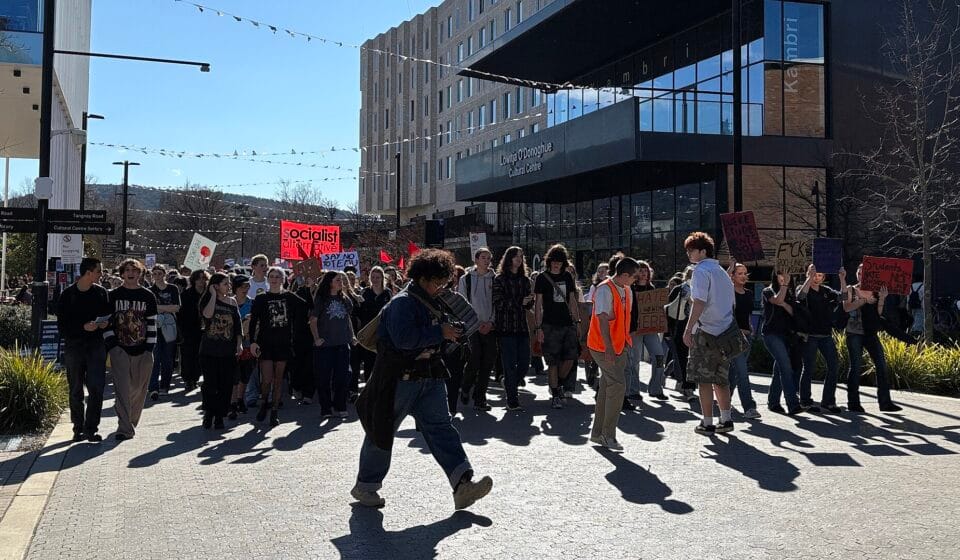
Students were told they should be in classrooms rather than protesting Pauline Hanson. But when young people peacefully engage with politics, scrutinise elected representatives and speak about decisions that will shape their future, are they stepping away from education or demonstrating exactly what education is meant to prepare them for?
The title deliberately echoes Hamlet’s famous question, “To be, or not to be.” For the students who took part, the dilemma was less existential but still meaningful: to strike or not to strike? To remain in the classroom, or to step outside it for a time and make their political views visible? On 13 August 2026, school and university students across Australia took part in coordinated protests against Pauline Hanson and One Nation.
Hundreds gathered in Melbourne, Sydney, Brisbane, Perth, Adelaide and regional centres. In Perth, organisers told the ABC that students from more than 100 schools had participated. But this was not simply a high-school walkout. The demonstrations were organised through the National Union of Students, and university students joined school students in the streets. The Guardian described high schoolers as joining coordinated university walkouts across the country. Many of the school students attending were too young to vote, while university students brought the perspective of young adults already experiencing tertiary education, student debt and the pressures of entering the workforce. Their decision attracted widespread criticism.
Pauline Hanson told students that schools should teach young Australians “how to think, not what to think” and suggested they should instead focus on falling wages, rising living costs and the economic future being left to them. Victorian Premier Ben Carroll, despite opposing One Nation politically, also argued students should remain in school and that education was the best way to change their future. But the response to the protests also revealed something important about how Australia views young people in politics.
We routinely tell students to think critically, examine evidence, understand democracy and develop their own views. When they then do exactly that and arrive at a strong political conclusion, it is worth taking them seriously rather than assuming they have simply been led there by someone else. That does not mean every student had the same reasons for attending, or that every slogan used at every rally represented every participant. It does mean the protesters deserve to be treated as young citizens capable of engaging with political ideas. And when Hanson tells students to concentrate on their education, another question becomes relevant:
What has Pauline Hanson actually done on education when given the opportunity to vote on it?
The protest was an exercise in democracy
Most school students cannot vote. A Year 9 student cannot express dissatisfaction with One Nation at the ballot box. A 15-year-old cannot vote against Pauline Hanson, Anthony Albanese or anyone else. Yet decisions being made today can affect their education, employment, housing and opportunities for decades. That leaves young people with fewer formal ways to participate in politics than adults.
University students were in a different position: most were old enough to vote, but they also had a particularly direct reason to pay attention to One Nation’s education policies. They are already living inside the higher-education system that Hanson and One Nation frequently criticise, and many will personally experience the consequences of decisions about university funding, HECS, international enrolments and the future shape of tertiary education.
At the Melbourne protest, a Year 12 student told the ABC that because people under 18 cannot vote, they should still be able to protest and express democratic views. A 15-year-old protester similarly spoke about concerns over what One Nation could do if it gained greater political power.
That is worth recognising for what it is: political engagement. Learning democracy is not limited to memorising the names of institutions or reading about elections in a textbook. It also involves learning how to form an argument, assess political claims, question people in power and participate peacefully in public life. Young people who research an issue, decide it matters to them and publicly express a view are not necessarily turning their backs on education. They may be demonstrating some of the very skills education is supposed to develop. The fact that some students chose to spend part of a school day expressing political views should therefore not automatically be interpreted as disrespect for education. For many of them, the subject of the protest was closely connected to education itself and to the future they expect education to help them build.
Hanson says schools should teach students how to think
There is an important principle in Hanson’s response that should be taken seriously. Schools should teach students how to think rather than what to think. Students should learn how to question information, distinguish evidence from opinion, recognise misinformation, understand competing arguments and reach their own conclusions.
But that principle should also apply when students reach conclusions politicians dislike. One Nation’s current Queensland education policy argues that students are being “indoctrinated into fringe political causes by activist teachers” and promises to remove material it considers outside traditionally taught subjects.
The party also proposes strengthening parental control, creating parent-dominated school boards, introducing a school voucher system and removing what it regards as ideological or politically biased content from classrooms.
That creates an important tension.
If young people are genuinely to learn how to think, they need opportunities to encounter difficult subjects, conflicting perspectives and ideas with which they, their teachers, their parents or their politicians may disagree. Critical thinking cannot mean simply reaching an approved conclusion. It means having the confidence and intellectual tools to examine an argument and sometimes say: I disagree.
That is precisely why dismissing politically engaged students as indoctrinated can be so unconvincing. Some may have been influenced by friends, teachers, family or social media, just as adults are influenced by the people and information around them. But influence is not the same thing as an absence of independent thought. Young people are capable of forming political opinions of their own.
Education is often where right-wing populism fights its culture wars
The debate around One Nation also sits within a much broader international pattern.
It would be too sweeping to say that every right-wing populist party always tries to control education. Governments of many political persuasions make decisions about curricula, school funding and educational standards. But researchers studying the populist radical right have found that education has increasingly become a deliberate arena for cultural politics, particularly around national identity, religion, history, minority groups, parental authority and what should or should not be taught.
Research published through the European Consortium for Political Research describes education policy as a growing part of the populist radical right’s agenda across Europe. Researchers Oliver Gruber and Philipp Schnell found that these parties increasingly use schooling to advance ideas about national culture and identity, frequently presenting themselves as removing ideology from education while at the same time seeking to reshape curricula and institutions around their own preferred values. Their research points to recurring battles over language, majority religion, national history, discipline and cultural identity.
That is an important distinction. Almost every politician claims to want education to be objective. The political question is who gets to define what “objective” means.
The United States provides a striking contemporary example.
This is not happening in every American classroom, but Republican-led states have recently enacted laws requiring the Ten Commandments to be displayed in public-school classrooms. Texas passed such a law in 2025, requiring the display in public-school classrooms, alongside other measures dealing with prayer, Bible reading and school-library material. Louisiana went further: its law requires Ten Commandments displays in public K–12 classrooms and public university classrooms. After extended litigation, a federal appeals court in February 2026 cleared the way for Louisiana’s law to take effect, although further constitutional challenges remain possible. Arkansas enacted a similar requirement, but a federal judge struck that law down in 2026. These measures have become part of a wider American argument about religion, parental rights and who determines the values presented inside public education.
The point is not that the Ten Commandments themselves are inherently objectionable, nor that religious ideas have no place in the study of history, culture or religion. Many students may personally regard the Commandments as deeply important. The issue is the difference between teaching students about religious traditions and a government ordering a particular religious text to be permanently displayed in every classroom, including classrooms where the subject has no obvious connection to religion.
That example also exposes a tension that is relevant to Hanson’s argument. Political movements can accuse teachers and universities of imposing ideology while simultaneously seeking state power to determine which values, texts and interpretations should receive official prominence in classrooms.
One Nation’s policies are not identical to those being pursued in Louisiana or Texas, and it would be unfair to pretend that they are. But the underlying political debate is recognisable. Hanson argues that Australian education has been captured by ideological activists; One Nation proposes greater parental authority and the removal of material it regards as political or ideological. Similar arguments overseas have become the justification for governments taking a much more active role in deciding what classrooms display, what libraries contain and which cultural values schools should reinforce.
That makes student interest in these questions particularly understandable. Education is not merely another policy portfolio for young people. It is the institution they spend much of their lives inside. When political movements argue over what their schools should teach, what their universities should value and which ideas should be excluded or elevated, students are not outsiders intruding into an adult political dispute.
They are among the people most directly affected by it.
Does One Nation not want to defund education?
Criticism of One Nation should still be accurate.
It would be misleading to simply claim that One Nation wants to defund schools.
Its published policy explicitly supports public funding for both government and non-government schools. It advocates what it calls a “back-to-basics” approach centred on English, mathematics, science, literacy, numeracy and discipline.
Hanson has also supported significant education funding legislation.
In 2017, One Nation’s Senate votes helped the Turnbull government’s so-called Gonski 2.0 school-funding package pass. The legislation provided an additional $23.5 billion under the government’s funding model, although Labor argued that it represented substantially less funding than schools would have received under its previous trajectory.
So the issue is not that Hanson has opposed every dollar spent on education.
The more revealing question is which forms of education spending she has supported, and which she has opposed.
What Hanson’s voting record shows
Politics can easily become, to borrow Hamlet’s wonderfully dismissive phrase, “words, words, words.” That is why Hanson’s voting record matters. Speeches and slogans tell us how politicians want to present themselves; parliamentary divisions show what they were prepared to support when their vote actually counted.
Or, to adapt another famous line from the play: the voting record is the thing. Hamlet says “the play’s the thing” as he searches for a way to test what is really true. Voters can perform a similar test by looking beyond political rhetoric and examining the decisions politicians make in parliament.
Independent parliamentary tracking organisation They Vote For You currently categorises Hanson as having voted “almost always against increasing funding for public schools.”
That description comes with an important qualification: it is based on a relatively small number of specifically classified parliamentary divisions, so it should not be treated as a complete account of every education vote Hanson has ever cast.
The individual votes are nevertheless relevant.
In July 2019, Hanson voted against a motion seeking a dedicated federal capital-works fund for public schools.
In December that year, she voted against a motion seeking additional assistance for government schools affected by drought.
Her record on tertiary education provides further context.
They Vote For You categorises Hanson as generally against increasing funding for university education. One significant example was her support at second reading for the Morrison government’s 2020 Job-Ready Graduates reforms, which dramatically restructured university fees and Commonwealth contributions. She was absent for later final votes on that legislation.
University students had a reason to pay attention
It would go too far to say that One Nation is opposed to universities existing. Hanson has spoken in favour of academic freedom, and the party does not advocate abolishing higher education. But One Nation is deeply sceptical of the contemporary Australian university sector, and Hanson’s rhetoric towards universities has frequently been adversarial.
In July 2026, Hanson told the Senate that Australia needed to “break our universities of their addiction” to international students. One Nation has argued that universities have become too dependent on international-student revenue, supports tighter limits on foreign enrolments and has called for greater scrutiny of how tertiary institutions are funded.
That sits alongside Hanson’s parliamentary voting record. They Vote For You currently classifies her as generally against increasing funding for university education. That classification is not proof that she opposes universities themselves, but it does demonstrate a long-running reluctance to support many proposals that would expand public investment in the sector.
One Nation’s criticism also extends beyond funding. Hanson has repeatedly argued that universities have become politically ideological, while presenting vocational education, apprenticeships and employment-focused training more favourably. The picture that emerges is therefore not simply “education versus no education”. It is a preference for a different model of tertiary education, accompanied by strong suspicion of much of the existing university establishment.
That distinction matters when considering the August protests. For university students who joined them, One Nation was not an abstract political subject being discussed somewhere outside their education. They were protesting a political movement whose leader has questioned the funding, priorities, international character and culture of the institutions in which they study.
Their presence also makes the protests harder to dismiss as merely schoolchildren being encouraged to skip class. The demonstrations brought together younger students who could not yet vote and university students who could, two groups at different stages of education but with a shared interest in what Australia’s education system may look like in the future.
On fee-free TAFE, her record is more complicated.
Hanson voted against amendments in 2023 and 2025 advocating broader fee-free tertiary education, while being absent for several other relevant votes. As a result, They Vote For You categorises her record as “almost always against making TAFE education fee-free.”
Yet One Nation has not rejected vocational education altogether.
During debate over Free TAFE legislation in 2025, the party sought to prioritise fee-free places for Australians rather than visa holders. Hanson has also supported some measures helping apprentices and vocational education.
Even on student debt, her position has not been entirely one-sided. In July 2025 Hanson voted for an amendment to cap HECS indexation at 3 per cent, although she was absent for the eventual vote passing Labor’s 20 per cent reduction in existing student debt.
The evidence therefore points to something more nuanced than simply calling Hanson anti-education.
She has a particular vision of education — one more supportive of some forms of vocational training and traditional schooling, and more sceptical of other forms of public-school and university spending.
Students are entitled to examine that record and decide whether it represents the educational future they want.
Perhaps the students have been paying attention
This is where the criticism of the protesters becomes particularly interesting. One Nation figures have suggested that students are being manipulated or politically indoctrinated. But students are repeatedly told that a good education should help them:
- research politicians,
- consider evidence,
- understand democracy,
- recognise competing claims,
- and think critically.
If students then research One Nation’s policies, look at Hanson’s parliamentary votes, listen to her public statements and conclude that they strongly disagree with her, that conclusion should not automatically be dismissed as indoctrination simply because it is inconvenient to One Nation.
Otherwise “think for yourself” risks becoming “think for yourself, provided you reach the conclusion I prefer.”
The same democratic principle applies to students who reach the opposite conclusion. A young person who researches One Nation and decides to support it is also entitled to that view. The role of education should not be to dictate which political party students support. It should give them enough knowledge, confidence and critical ability to scrutinise all of them.
There is even a line in Hamlet that captures that ideal surprisingly well. Polonius advises, “Give every man thine ear, but few thy voice … reserve thy judgment.” Whatever we think of Polonius as a character, the advice suits democratic education: hear different arguments, test them carefully and make up your own mind rather than simply repeating what someone else has told you.
What was striking about these protests was that many young Australians appeared willing to do exactly that. They were not waiting until adulthood to become interested in democracy. They were already participating in it, and this is a good thing.
Education is about more than classrooms
There is also a wider issue behind the protests. Australia tells young people that education is one of the foundations of a better future. Study hard. Get qualified. Learn a trade. Go to university. Work hard.
Yet the generation now moving through schools and universities is also confronting extraordinary house prices, significant student debts, cost-of-living pressures and uncertainty about whether it will enjoy the same opportunities as previous generations. Hanson herself pointed towards wages and the cost of living when responding to the protesters.
Those are legitimate concerns. But that makes young people’s scrutiny of political parties more important, not less. They are entitled to ask One Nation, just as they should ask Labor, the Coalition, the Greens and every other political movement, what its policies and parliamentary votes would mean for their schools, universities, TAFEs, employment and future living standards.
Young people do not owe politicians automatic agreement simply because they are young. Politicians who want their support need to persuade them.
So, to strike or not to strike?
There is no need to pretend that leaving class is the only meaningful form of student political participation. It is not. Young people can engage with democracy in many ways, from classroom debate and student journalism to community organisations, correspondence with MPs and public forums. But the school and university students who took part in the August demonstrations should not be dismissed simply because they chose a highly visible way to express their views. Their participation showed that a generation often accused of being apathetic is actually paying attention. They were reading political messages, responding to national debates and trying to make themselves heard before many of them had even reached voting age.
That is not something a healthy democracy should be frightened of. Nor should adults expect young people to wait patiently until their eighteenth birthdays before forming opinions about decisions being made in their name. The better response is to take their arguments seriously. Ask whether their claims are supported by evidence. Examine the politicians they are criticising. Look at the policies and the voting records. And give young people enough respect to believe they are capable of doing the same.
Perhaps one final line from Hamlet belongs here too: “This above all: to thine own self be true.” Young Australians should not be expected to inherit the politics of their teachers, parents, friends or politicians. They should be given the freedom and the education to reach conclusions of their own.
Because if Pauline Hanson is right that education should teach Australians how to think rather than what to think, then students who examined her politics, reached their own conclusion and peacefully expressed it were not demonstrating a failure of education.
They were demonstrating its value.
References
- ABC News — “Students down books to rally in Australian cities against One Nation and Pauline Hanson”, 13 August 2026. This is probably your main factual source for the demonstrations and Hanson’s response.
- ABC triple j Hack — student protests against One Nation, which explicitly reports students walking out of school and university, making it especially useful for your tertiary-education section.
- The Guardian — “‘Everything is on the line’: students … join anti-Hanson protests across Australia”, 13 August 2026. Useful for accounts from participating students and the National Union of Students’ role.
- Pauline Hanson’s One Nation — Queensland Education Policy. Primary source for the party’s claims about “activist teachers”, curriculum, parental control and school vouchers.
- Pauline Hanson’s One Nation — international-student/university policy statement. Useful for Hanson’s argument that Australian universities need to be broken of their dependence on foreign students and should prioritise Australians.
- They Vote For You — Pauline Hanson: increasing funding for public schools. It identifies her two No votes on the public-school capital works fund and drought assistance, as well as the site’s methodology and the limited number of relevant divisions.
- They Vote For You — university funding and Fee-Free TAFE. These provide the voting-record evidence behind the tertiary-education sections.
- European Consortium for Political Research — Gruber & Schnell, “Populist radical-right parties are developing distinct education policies.” This is the key academic/political-science source for your broader argument about populist radical-right movements treating education as a political arena.
- Texas Legislature — Senate Bill 10. The enacted text requires a Ten Commandments display in each public elementary and secondary school classroom, making this a much stronger source than relying on a newspaper description.
- Louisiana Legislature — Act 676/HB71. Louisiana’s legislation covers public K–12 classrooms and public postsecondary classrooms, which is particularly relevant to your discussion of both schools and universities.