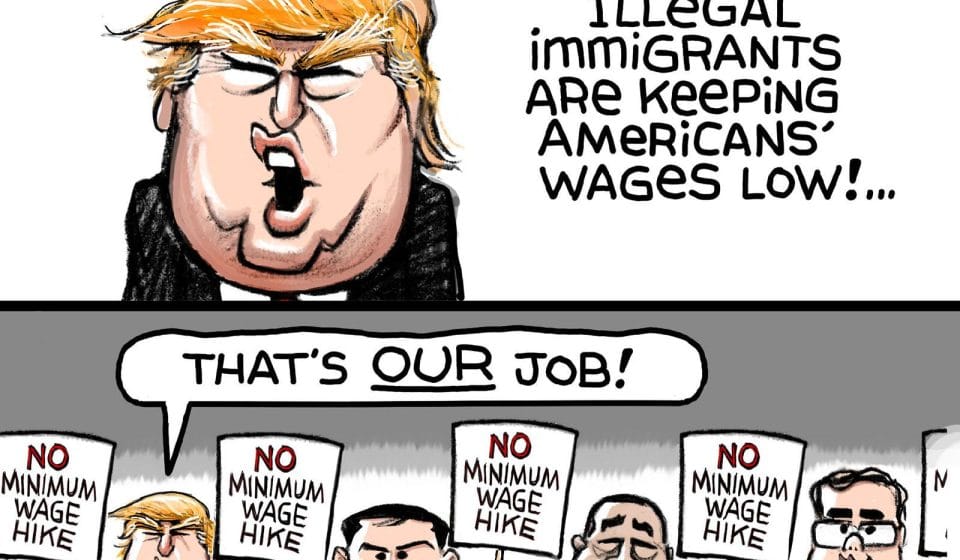
Fear-based politics follows a remarkably predictable script.
First, it identifies a group that is becoming more visible, such as women in leadership or migrants in the community.
Then it tells people who feel economically or socially insecure that this group is responsible for what they are losing.
You did not miss out on a promotion because your employer undervalued you or because senior appointments are opaque. A woman took your job.
You cannot afford a home because governments neglected housing supply, infrastructure and social housing. A migrant took your house.
Your wages are stagnating because employers have weakened bargaining power or exploited temporary workers. An immigrant took your job.
You feel unsafe because of complex failures in policing, prevention and social services. Foreigners brought crime.
This is not an explanation of insecurity. It is a redirection of it.
Research has found that exposing people to threatening messages about immigrants can increase support for punitive immigration policies. Fear is politically useful because frightened people are more likely to accept simple answers, collective blame and harsher government action.
Charlie Kirk and the campaign against women’s ambition
Charlie Kirk used this style of politics when discussing women’s education, employment and family lives.
At a Turning Point USA event for young women, Kirk declared that having children was more important than having a good career and told women they could return to their careers later.
The problem is not encouraging people to value parenthood. Raising children is deeply valuable work, and many women freely choose to prioritise it.
The problem is presenting women’s professional ambitions as a mistake while ignoring the structural barriers that make returning to work difficult: lost experience, reduced superannuation, childcare costs, employer discrimination and years of foregone promotions.
Kirk’s message forms part of a broader conservative argument that feminism has misled women into pursuing education, independence and professional achievement at the expense of marriage and motherhood.
At Turning Point events for young women, speakers have repeatedly promoted traditional gender roles and warned women against delaying marriage or children for their careers.
People should be free to become full-time parents. They should also be free to become engineers, executives, politicians, scientists or business owners.
Genuine freedom does not require women to adopt a particular lifestyle to preserve a supposedly natural social order.
It means making either path realistically possible.
Quillette and the The “feminisation” panic
A more intellectual-sounding version of the same anxiety appears in parts of right-wing media.
Quillette, for example, has published arguments about the alleged “feminisation” of institutions and opposition to gender quotas.
It is important not to misrepresent the publication as having one uniform position. Some Quillette articles have rejected the conclusion that women must be removed from public life or positions of influence. Other articles have opposed mandatory board quotas while acknowledging that they can increase women’s representation.
However, the language of “feminisation” can still encourage readers to interpret women’s participation as evidence of institutional decline.
Workplaces become supposedly too emotional, risk-averse, bureaucratic or politically correct—not because of management fashions, incentives or organisational structures, but because too many women have entered them.
This is an old prejudice wearing modern business language.
It also bears little resemblance to the claim that women have taken over corporate Australia.
Women make up roughly half the workforce, but remain underrepresented in senior management and chief executive roles. Their representation generally declines as positions become more senior, while Australia continues to have a substantial gender pay gap.
Women are not dominating the commanding heights of business. They remain significantly underrepresented within them.
Are gender targets an attack on men?
Gender quotas and targets can be debated.
A badly designed system can become tokenistic, focus too narrowly on boardrooms or benefit a small group of already-privileged women without improving conditions for ordinary workers.
But that is different from claiming that gender-equity measures allow unqualified women to seize positions from deserving men.
International research examining board-gender policies has found that quotas can successfully increase women’s representation. The negative economic consequences predicted by critics have generally been far less dramatic than the rhetoric suggests.
The evidence supports a measured position: quotas can change who reaches the boardroom, but they are not a complete gender-equality policy.
They need to sit alongside transparent recruitment, parental leave, accessible childcare, flexible work, protection against harassment and fair promotion processes.
The implication that male executives reached their positions through pure merit while women only advance through preferential treatment is particularly questionable.
Corporate leadership has never been a perfect meritocracy. Personal networks, private education, family connections, confidence, sponsorship and membership of the right social circles have always influenced who receives opportunities.
Measures designed to interrupt an entrenched old boys’ network are not the invention of unfairness. They are a response to unfairness that already exists.
“Migrants are stealing our houses”
There is a legitimate discussion to be had about migration levels. A rapidly growing population requires more homes, schools, hospitals, transport, water infrastructure and public services.
When housing supply is slow to respond, additional demand can place upward pressure on rents.
The Reserve Bank has estimated that additional international students can place some upward pressure on private rents when housing supply is constrained.
However, it also concluded that international students accounted for only a small share of the post-pandemic rent increase, much of which began before Australia’s borders fully reopened.
Construction costs, low vacancy rates, slow planning processes and insufficient housing supply have also played central roles.
Acknowledging that migration creates demand is not the same as saying migrants “steal” houses.
Migrants do not determine Australia’s migration intake.
They do not write state planning laws, decide infrastructure budgets, release land, set construction policy or determine how much social housing gets built.
Governments make those decisions.
Australia’s housing authorities have repeatedly identified social and affordable housing, planning reform, infrastructure, construction capacity, productivity and renter protections as essential parts of the response to the housing crisis.
When governments increase the population without ensuring housing and infrastructure keep pace, that is a failure of coordination and public policy—not evidence of moral wrongdoing by the people who were legally invited to live, work or study here.
Blaming the family attending a rental inspection is easier than confronting decades of underinvestment.
It is also far less useful.
“Migrants are taking our jobs”
Immigration can affect particular industries, regions and groups differently.
Employers can misuse temporary visas, underpay migrant workers or use insecure labour to weaken employment conditions.
These are real problems, and pretending otherwise only creates space for extremists.
But the culprit in those cases is the employer breaking or exploiting the rules—not the worker being exploited.
A major Productivity Commission analysis found little evidence that immigration had significantly harmed the overall employment outcomes of Australian-born workers during the period it examined.
The associations it identified were generally small and mixed, although the commission cautioned that effects may differ during economic downturns or under different migration settings.
Australia’s Migration Strategy has also acknowledged that some temporary visa arrangements can create power imbalances and opportunities for worker exploitation.
The answer is better regulation, stronger workplace protections and a more strategically managed migration system—not scapegoating migrants themselves.
Workers should demand strong wage enforcement, action against sham contracting and underpayment, visa portability so exploited workers can leave abusive employers, greater investment in apprenticeships and domestic training, and migration levels linked to genuine workforce, housing and infrastructure plans.
A migrant being underpaid is not the enemy of an Australian worker.
An employer using vulnerability to undercut both of them is.
“Migrants have taken our safety”
Perhaps the most inflammatory claim is that immigration has made Australians inherently unsafe.
Individual migrants can commit terrible crimes, just as Australian-born people can.
Every offender should be held accountable for what they have done.
But personal responsibility is replaced by collective guilt when one offender’s nationality is used to cast suspicion over millions of unrelated people.
Even apparently straightforward crime statistics must be treated carefully.
Victoria’s Crime Statistics Agency has warned that country-of-birth data cannot reliably establish what proportion of all crime is committed by people from a particular country.
Many offences are unreported, many offenders remain unidentified, and a person’s birthplace does not reveal their citizenship, visa status, ethnicity or how long they have lived in Australia.
A headline identifying a foreign-born suspect may be factually correct.
Using that case to imply that an entire migrant community is dangerous is not.
Good public-safety policy examines the actual causes and patterns of offending.
Fear politics searches for the most politically useful identity to attach to it.
Who benefits from the blame?
When men are told that women are stealing their promotions, they are less likely to question unfair employers, opaque hiring processes or executives who reserve opportunities for their own networks.
When renters are told that migrants stole their homes, governments face less scrutiny over planning failures, tax settings and inadequate public housing.
When workers are told migrants caused low wages, employers who underpay both migrant and Australian-born workers escape attention.
When every crime involving a foreign-born offender becomes a referendum on immigration, difficult questions about violence prevention, policing, rehabilitation and social services are pushed aside.
The people being blamed are usually those with the least power to create the problem.
Rejecting the false choice
We do not have to choose between denying genuine pressures and demonising groups of people.
Population growth must be planned responsibly.
Workers must be protected from unfair competition and exploitation.
Gender-equality programs should be transparent and evidence-based.
Crime must be addressed honestly, regardless of who commits it.
But women entering management are not stealing men’s futures.
Migrants looking for homes are not stealing Australians’ right to housing.
People who arrive in Australia seeking work, education, security or a better life are not a substitute for holding governments and powerful institutions accountable.
Fear politics tells us to look sideways at one another.
Real political courage requires us to look upward—towards the systems, decisions and concentrations of power that determine whether everyone has access to secure work, safe communities, affordable homes and a fair chance to succeed.