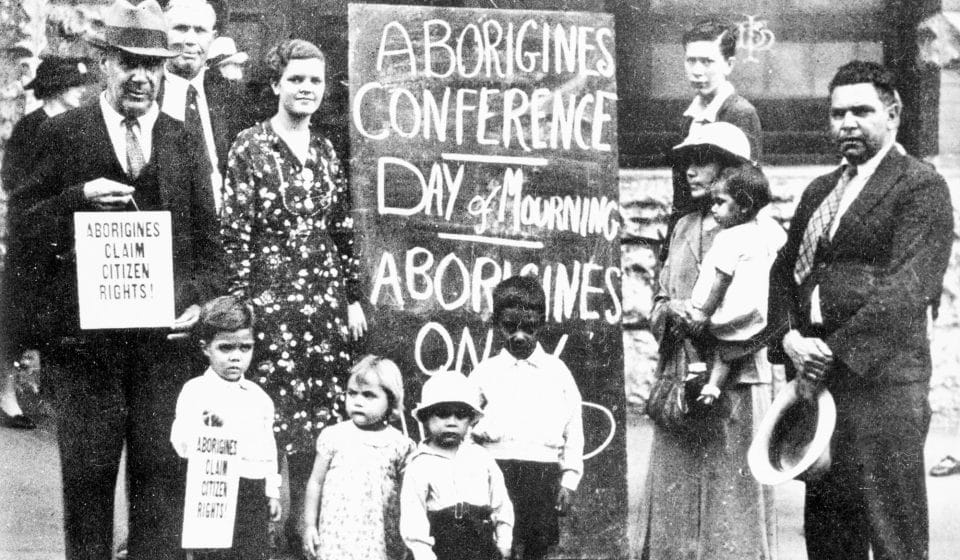
A common tactic used by the far or populist right is to sanitise Australia’s past so that modern racism can be repackaged as “common sense,” “protecting our culture” or simply “telling it like it is.”
British colonisation becomes peaceful “settlement.”
The violent dispossession of Aboriginal and Torres Strait Islander peoples becomes an unfortunate misunderstanding.
Frontier conflicts are pushed to the margins of our national story, while First Nations resistance is ignored or treated as criminality rather than people defending their families, land and way of life. AIATSIS describes the Frontier Wars as major conflicts involving the violent displacement of Indigenous peoples from their homelands.
The legal fiction of terra nullius encouraged the idea that Australia belonged to nobody before the British arrived—even though First Nations peoples had their own laws, cultures, political organisation and relationships with Country. It was not until the 1992 Mabo decision that the High Court rejected that fiction and recognised native title.
The Stolen Generations are sometimes reframed as governments merely “rescuing” disadvantaged children. But generations of Aboriginal and Torres Strait Islander children were forcibly removed under government laws, policies and practices. Missions and reserves often separated people from their land, families, languages and cultural traditions.
Even the White Australia policy is sometimes softened into a simple immigration policy suited to its time. In reality, one of the first acts of the newly federated Parliament was designed to restrict non-British and non-white migration. The National Archives describes it as a policy intended to maintain Australia as a nation populated mainly by white Europeans.
These distortions serve a modern political purpose.
Once colonisation is presented as entirely peaceful, First Nations demands for truth, treaty, recognition or justice can be dismissed as divisive.
Once the White Australia policy is stripped of its racism, politicians can recycle the same fears about migrants supposedly threatening Australian culture.
Once the Stolen Generations are treated as ancient history or good intentions gone wrong, the lasting damage to families and communities can be ignored.
Once past discrimination is erased, present inequality can be blamed entirely on the people experiencing it.
This is how racism is made socially acceptable. It is rarely presented openly as racial superiority. Instead, it is disguised as concern about “Australian values,” demands that minorities “assimilate,” claims that First Nations people receive “special treatment,” or accusations that discussing racism somehow divides the country.
But acknowledging history does not mean believing Australians today are personally guilty for everything previous generations did.
It means recognising that we inherited a country shaped by those decisions—including its institutions, wealth, borders, laws and social attitudes.
Australia has many achievements worth celebrating. We can honour the people who built our communities, defended democracy and helped create a successful multicultural society while also acknowledging dispossession, racial exclusion, forced removals and discriminatory laws.
A mature nation should be capable of doing both.
Truth-telling is not hatred of Australia. It is confidence that our national identity is strong enough to survive honesty.
Whenever a politician tells us to stop talking about the past, we should ask:
Whose actions are being excused? Whose suffering is being erased? And what present-day prejudice are they trying to make acceptable?
You cannot learn from a history you have deliberately rewritten—and you cannot overcome racism while pretending it never shaped Australia.