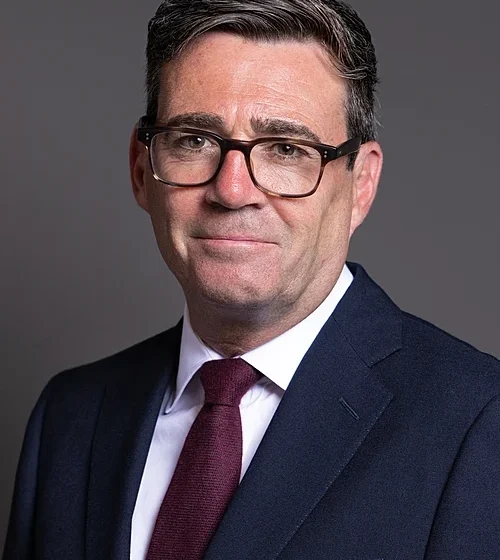
Could More Women Help Renew Labour Under Andy Burnham?
Andy Burnham is not taking control of the British government at an easy moment.
Less than two years after Labour won a commanding parliamentary majority, the party has fallen badly behind Reform UK in national polling. A YouGov poll conducted on 12 and 13 July placed Reform UK on 24%, while Labour and the Conservatives were tied on just 19%. Reform had also topped national opinion polls for months and was the principal beneficiary of Labour’s heavy losses in the May 2026 elections.
Labour is therefore in urgent need of more than a change of leader. It needs a broader political, cultural and generational refresh one capable of convincing voters that the government has listened, learned and is prepared to govern differently. Giving more women genuine authority within the government could become an important part of that renewal.
After a period of internal conflict, policy reversals and falling public confidence, a Cabinet containing more women in genuinely powerful positions could help demonstrate that Labour is prepared to change how it governs. It could also provide the party with perspectives and leadership styles that have too often been excluded from the highest levels of political decision-making.
To address the issues that Labour has faced, Burnham has promised to confront what female Labour MPs have described as a damaging culture of misogyny, exclusion and hostile political briefings. He has reportedly pledged that women will be represented in important meetings and warned that Downing Street staff responsible for misogynistic briefings against female ministers would be dismissed. That does not mean appointing women simply to improve Labour’s image or satisfy a numerical target. It has to be said: women should not be treated as political decorations or used as evidence of change while the same small group continues to make every important decision
A meaningful refresh would involve placing capable women at the centre of economic, foreign, security and social policy, not merely inviting them into the room after the major decisions have already been made.
Burnham has also promised that his ministerial team will reflect different parts of the Labour Party and Britain’s communities. He has also presented his leadership as Labour’s opportunity to reverse its political decline and confront Reform UK through a more confident and authentic Labour identity rather than attempting to imitate Nigel Farage’s politics.
Reports have identified Shabana Mahmood as a leading candidate to become Chancellor of the Exchequer, while several other senior Labour women have been discussed as possible members of Burnham’s top team. Burnham had not confirmed those appointments before taking office, however, meaning his eventual Cabinet, not the speculation surrounding it will provide the real test of his commitment.
After a period of internal conflict, policy reversals and falling public confidence, a Cabinet containing more women in genuinely powerful positions could help demonstrate that Labour is prepared to change how it governs. It could also provide the party with perspectives and leadership styles that have too often been excluded from the highest levels of political decision-making.
More women around the table will not automatically repair Labour’s standing or defeat Reform UK. Representation cannot substitute for effective policies on housing, wages, public services, the cost of living and regional inequality. But a government that more closely resembles the country it serves may be better equipped to understand those problems, challenge its own assumptions and rebuild public trust. or Burnham, promoting women into senior positions could therefore be more than a symbolic gesture. Done properly, it could become part of the political and cultural reset Labour desperately needs.
How Do the United Kingdom, Australia and the United States Compare?
For the fairest comparison, it is useful to examine the elected lower house in each country.
Australia: 46% Women
Following Australia’s 2025 federal election, women held 46% of the seats in the House of Representatives. Women also made up 56.6% of the Senate, bringing female representation across the entire federal Parliament to 49.6%—the closest Australia has come to parliamentary gender parity.
Australia has nevertheless had only one female prime minister, Julia Gillard. Its parliamentary numbers are now impressive, but equal representation in Parliament does not automatically guarantee that women will always receive an equal share of the most influential leadership positions.
United Kingdom: Approximately 41% Women
As of March 2026, women made up approximately 41% of the House of Commons. Ten of the 22 members of the Cabinet at that time were women, although those figures preceded Burnham’s new government.
Britain has had three female prime ministers, Margaret Thatcher, Theresa May and Liz Truss, but the Labour Party has never elected a woman as its permanent leader. Burnham therefore inherits a party that has achieved substantial female representation in Parliament while still facing questions about who receives power at the very top.
His Cabinet appointments will reveal whether his promise of cultural change is reflected in the distribution of senior jobs.
United States: Approximately 29% Women
The United States continues to trail both Australia and the United Kingdom. As of April 2026, 128 women served in the 435-seat US House of Representatives, while 26 women served in the 100-seat Senate. That placed women’s representation across Congress at just under 29%.
The United States has elected a woman as vice-president, with Kamala Harris becoming the first to hold the office, but it has never elected a woman as president.
Despite its international influence and frequent claims of democratic leadership, the United States remains considerably further from gender parity in national politics than either Australia or the United Kingdom.
Sources for the article
- Reuters — “UK’s Burnham says new cabinet will reflect all parts of Labour Party”
Supports the statement that Burnham intends his Cabinet to reflect different Labour traditions and communities, while confirming that appointments had not yet been decided. - The Telegraph — “Burnham: I’ll have women in every meeting”
Supports the discussion of Burnham promising female representation in important meetings and warning that aides responsible for misogynistic briefings would be removed. - Reuters — “Andy Burnham to become prime minister, pledging to ‘rewire Britain’”
Supports the broader account of Burnham becoming prime minister and the reporting around his potential senior appointments, including Shabana Mahmood. - House of Commons Library — “Women in Politics and Public Life”
As of March 2026, approximately 41% of UK House of Commons MPs were women. Ten of the then 22 Cabinet members—about 45%—were women. The Cabinet figure predates Burnham’s new ministry. - Australian Parliamentary Library — International Women’s Day 2026 analysis
Women comprised 49.6% of all members of Australia’s federal Parliament when the current Parliament opened, bringing Australia close to overall gender parity. - Inter-Parliamentary Union — Women’s representation in parliament
Women won 46% of seats in Australia’s House of Representatives at the 2025 election. This is the most suitable Australian statistic when comparing lower houses. - Clerk of the United States House of Representatives — Women in the 119th Congress
As of 14 July 2026, there were 155 women serving in the US Congress: 128 in the House and 27 in the Senate. Women therefore occupied roughly 29% of congressional positions, depending on whether non-voting House delegates are included in the calculation.